
The 57X Problem for Padel
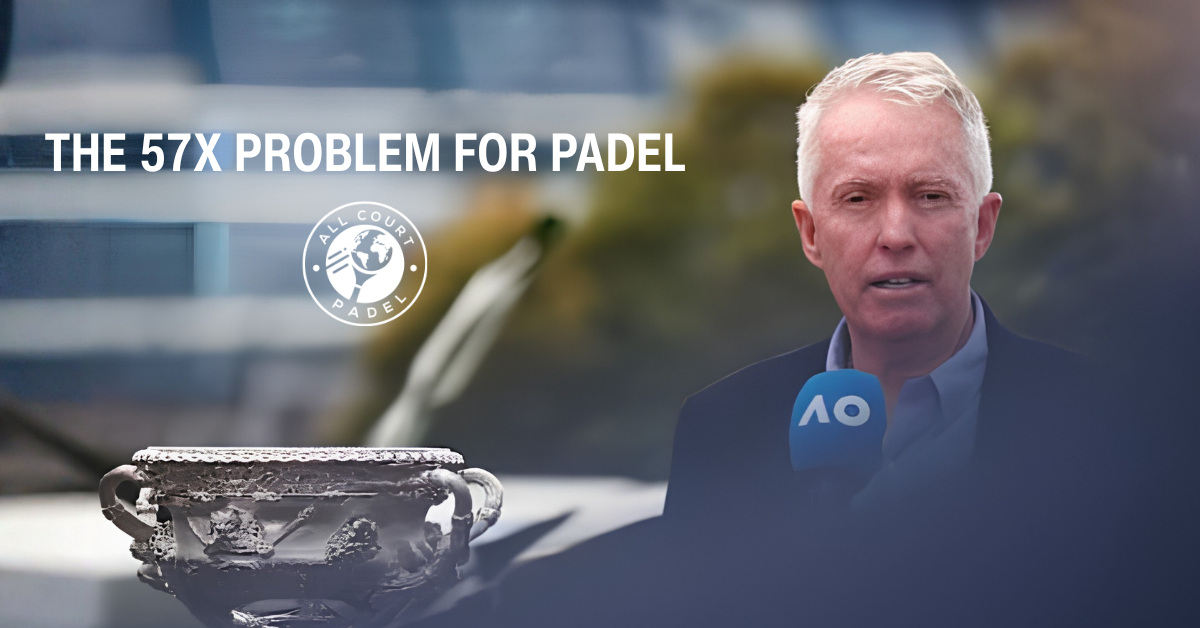
Craig Tiley, above, spent his career in tennis closing this gap.
I’ve just finished the Business of Sport episode with Craig Tiley, the man who ran the Australian Open for the best part of two decades and is now off to run tennis in the USA. It left me with a stack of lessons padel could take from his experience, and one of them matters more than all the others.
Win a padel Major, one of the four biggest titles in the sport, and you’ll take home around €47,000. Win a tennis Grand Slam and you’ll clear €2.8m. Reach a Grand Slam semi-final and you’ll pocket roughly what padel’s highest earner made in the whole of 2024. One recent count put the gap between a Slam winner and a Premier Padel Major winner at about 57 times.
That number is the most interesting thing in padel right now. Not because it’s unfair, but because it tells you exactly what kind of problem the sport has.
It doesn’t have an attention problem. It has a commercialisation problem.
Padel is the fastest-growing sport in the world. Courts are going up faster than clubs can staff them, and the pro game draws crowds that would have been unthinkable five years ago. The eyeballs are there. What isn’t there yet is a machine that turns those eyeballs into money and feeds it back into the sport.
This is the exact gap Tiley spent his career closing in tennis. Underneath everything he says about the Australian Open sits one idea: a big audience is worthless until you own the machine that turns it into money. He didn’t just grow the crowd. He built the show around it, brought the broadcast in-house, and pushed until media and content made up more than half of Tennis Australia’s revenue. The tennis was almost the raw material. Attention was never the achievement. Converting it was.
Sit with that, because it’s counterintuitive. We assume the product is the sport. Tiley worked out the product was the experience, and the sport was the thing at the centre of it.
Padel has the harder half already done. It has the attention, and arguably a better raw material than tennis ever had: glass walls you can put a camera behind, four players close enough to mic up, rallies a complete beginner can follow in ten seconds. It is watchable and social in a way tennis has to work at. And still, the best pair in the world earns a fraction of what a mid-tier tennis player banks, because the machine around padel is young and thin.
So the 57x number isn’t a moan about fairness. It’s a map. It tells you the sport has finished the part everyone finds hard, winning attention, and has barely started the part that actually pays, converting it. For a global tour that machine means broadcast you control, sponsors who pay for your audience, and fans you can reach directly. Scale it right down and it’s the same three things for a club, or a coach.
Over the next few posts I’ll pull apart how padel is trying to close that gap, and where I think it’s getting it right and wrong. There’s a clever strategy hiding in plain sight on YouTube. There’s an economics story in who really pays the players that most fans have completely backwards. And there’s a lesson in all of it for anyone running a padel business here, including me.
But it starts with the one idea Tiley would recognise instantly. Padel has won the attention. The only question that matters now is whether it’s building the machine, or just handing free content to everyone who already owns one.
